This is one of my favorite paper plane designs and I used to have a lot of them when I was a child. To make this paper throw more unique, the plane had an asymmetry design with smaller right wing and a hole in the middle, which makes the plane turn right after I release it. The angle to throw and speed was crucial and it took me a couple of trials before understand how this plane behaves. This assignment distracts me a bit from boring social-distancing and brings back my paper plane skills I used to have.
For the first hometask, I chose to kick a crumbled up piece of paper into my garbage bin. One of the hardest things to do in American football is punt a football down the field because of the ball’s rotation and unique shape. A crumbled up piece of paper has no clear shape and is rough around the edges, so I figured I would try and test my skills at punting a piece of paper. I stood at the top of my stairs, dropped the piece of paper, and hit it against the wall and into my garbage bin. This throw / kick was spectacular because I had to drop the paper on a certain part of my foot to ensure it would go in the correct direction. I also had to put just enough power into the kick to make sure it ended up in the bin. This task turned out to be much more challenging than I imagined, but I did not mind it because I don’t have much else to do these days.
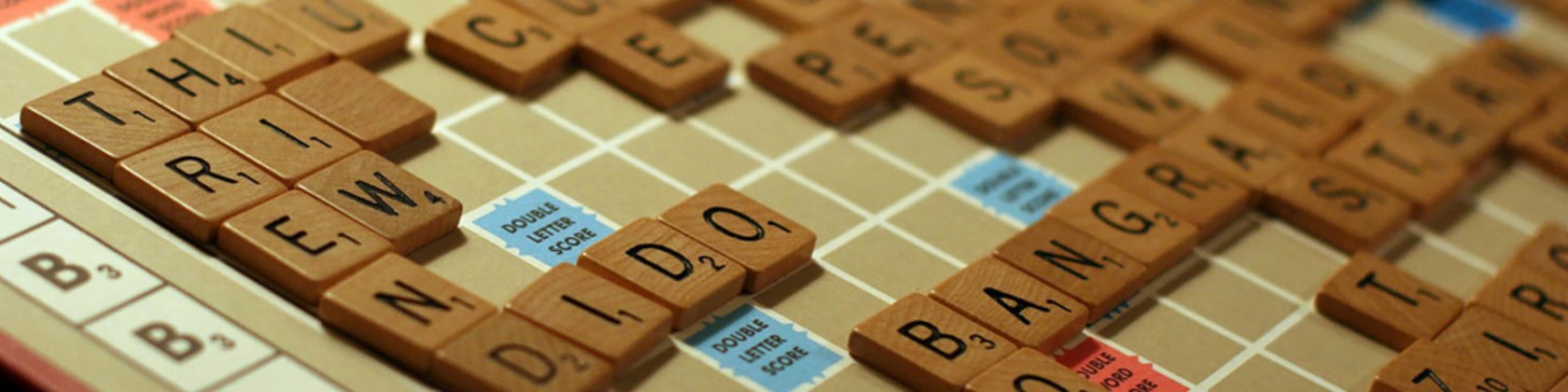
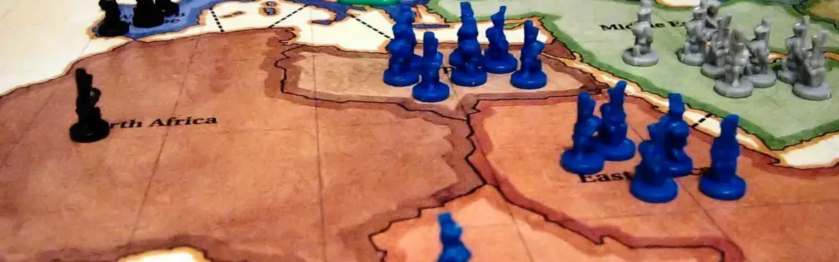
When creating “Risky Business: A Deep Dive Into The Game of Risk,” my group first met with Professor Morgen to brainstorm potential angles to explore, and then we “deep dove” into those topics. We researched game strategy, the history of the game, different scenarios that a player could encounter, and the game’s real-world applications to the Cold War and beyond. We researched by reading articles, instruction manuals, history accounts, timelines, and discussing our own knowledge of the game. As co-Assistant Producers, Giovanni and I focused more on the research aspect and Will, the Producer, focused on developing our research into a flowing, cohesive, and entertaining script. I organized a space to record and gathered the recording materials, and Giovanni edited the audio after recording. We derived inspiration from podcasts that came before ours by listening to them and extracting some aspects we liked. Some of these tactics included having short conversations with each other throughout various moments of the podcast as well as talking through some specific scenarios during game-play.
Our primary goals in our podcast were to examine Risk’s history, it’s association with the Cold War, and how the game’s medium and rules provide understanding about Cold War-era thinking. To achieve these goals, we described the premise of game-play and the historical context of when it was created and initially played. We executed this goal by creating an interactive dialogue that kept the reader engaged and interested. We knew it would be easy to slip into the dangerous waters of making a podcast that mimicked a Cold War history lesson. Thus, we worked hard to incorporate comedic breaks and conversations between players. We also carefully chose background music that fit with the game’s theme: serious to an extent but also mysterious and creative. Some areas I wish we had time to further explore are the moral implication of Risk on the modern player. We examined the Cold War-era implications but I feel there were more connections we could have made for how Risk encourages a higher moral standard and strategic way of thinking through daily tasks.
My work on the podcast episode helped me achieve the learning outcomes for the semester by composing texts in multiple genres using the written and aural modes. I am accustomed to writing just for a reader’s eye, but for the podcast, we had to think about writing for a speaker. This was a more crafty type of writing that required oral experimentation to see how the tone felt and if our words made sense when spoken out loud. I also practiced writing as a process, recursively implementing strategies of research, drafting, revision, editing, and reflection. When creating the podcast, we composed many drafts of our script, re-recorded countless segments, and rethought the structure multiple times after we’d already finished recording. Creating this podcast taught me the importance of fine-tuning and revising to create a successful end product.
Through creating this podcast, I have learned that my strengths include compiling information, organizing a group, and being receptive to others’ ideas. Some areas I could improve upon are mastering the technological aspects, such as editing sound and recording audio. I can apply the skills I used in crafting this podcast episode to future writing projects by carefully revising all of my work and taking input from my peers into consideration.
I chose to print out a 20-sided die because I really like dice since they are related to mathematics and also I could use as an interior decoration. I was particular about the number of faces of the die to print because an icosahedron has the most number of faces out of the five possible polyhedrons. I was really impressed by the quality of the 3-D printer and was fascinated by how the printer calculated before it started printing. Also, I wondered what this die is made of: it has a plastic-like touch feeling, but sides are powdery.
I did not face any problems when I was trying to find the stl file of my product or when I try to print my product. I did not find any challenge to find the file because the file is in demand; it is convenient to use a 3-D printer to obtain this type of dice. I also did not face any challenge to print my product because there was a person who adjusted the scale of my object when I printed out.
Due to time-restrictions and technological difficulties, our podcast production process was very cooperative. After a group brainstorming session, we decided that Risk would provide more potential discussion over the other games we were considering. As Risk is such a dynamic game, we could analyze individual situations and decision making processes. After deciding on Risk, we all completed individual research about Risk with specific foci ranging from Risk’s history to rule changes. After consolidating our research onto one document, as the Producer for this episode, I wrote a script. The other collaborators helped edit and build the script to be more compelling, such as “game-excepts” and comedic breaks. Next, we spent about six hours over two days recording the podcast, then passed the editing responsibilities onto Giovanni. Considering his extensive background in musical production, he is very familiar with audio editing and expedited the finalized version rapidly.
For our podcast, we tried our best to avoid being a hard-listen. More specifically, Podcasts, if not completed correctly, can be very dry and difficult to listen and pay attention to. Consequentially, we tried to be as entertaining as possible; we attempted to achieve this through comedic breaks, an active script that tries to engage the listener, and upbeat music with breaks from monologues. Smaller details included constant and intermittent switching of speakers to avoid monotony. Challenges included creative differences and script organization; for example, background music was a point of contention through the group. Besides more idealogical distinctions, we worked extremely well as a group. From finding time where we can all work on the podcast to our strengths coming together, our group collaborated competently.
By definition, creating a podcast episode forced our group to compose a text in a new medium. Adapting to a different type of writing with different intentions was a unique provocation. With an essay, a given format is expected and deviations are unexpected; in contrast, the podcast should be as unpredictable as possible to maintain listener enjoyment and attention. Rather than constructing an argument in a linear logic based fashion, our podcast tries to jump from our narrative to examples from a hypothetical game. This form of writing resembles a formal literary essay where the typical format includes a topic sentence supported with direct evidence from the source. Personally, I am most proud of how our group collaborated and utilized each of our individual capacities for different elements of the podcast.
This is a 3D model of Batman Tumbler. This piece is special for me since I have been a great fan for the batman trilogy, and the scene of this tumbler jumping off rooftops and destroying anything in the way left a great impression for me about this special vehicle. I always love cars and having a car on my desk has been a tradition for me. Since I have not had the chance to bring my own model cars here to emory, this is a great chance for me to refill my car collection and have something I like on my table.
I found this model on thingiverse and I was very impressed with the level of details this car has. The only challenge I has was the size of the model was way larger than the printer’s capacity and we have to rescale it to around 0.1% of its original size to print this out. And also, cutting out the supporting pieces was hard to accomplish. I was so scared to cur pieces out that are necessary for this model. I really like this project.
I chose to print the mask of a character from the game League of Legends, the virtuoso, Jhin. Ever since this champion came out, he immediately became my favorite champion of all; everything about him was irresistibly attractive to me –the mysterious background, the unseen face hiding behind the emotionless mask, and, the best of all, those eyes in the dark that shine wildness and chaos, actively searching for the next target.
Jhin is a talented musician, as well as a meticulous criminal, who believes murder is art. The title of this side quest is a quote from him that resembles his characteristic as someone who gains pleasure from delivering terror. Like some other villains from thriller movies and novels, Jhin is a perfect combination of charm and lunatic who create works of artistic brutality and terrifying victims. Jhin reminds me of the Jigsaw Killer and V from V for Vendetta because all of them have a mask that represents their identity. Personally, I love how the designer incorporated the idea of ‘mask’ into Jhin because the mask truly brings out the shadowy, dark elements of this champion, builds up Jhin’s identity as a “psychotic serial killer”, which is also why I immediately thought of his mask when doing this assignment.
There was no hardship in finding the sdl file of this 3D model. If there’s one obstacle I have to express, I would say the removal of the support underneath the mask, since the mask is thin and curved, I was worrying the whole time that I might break it. Gladly, it turned out fine. Also I was pleasantly surprised by all the refining details on the model, super cool!
I have to say printing something with a 3D printer was an exciting experience. The first time I saw one of those was in high school. Some rich and philanthropic alumnus donated ten 3D printers, so our technology class’s (I don’t know if that’s the correct translation) biggest assignment became learning how to design an object and print with a 3D printer. I tried to make an Avengers bracelet, but twice I failed to adjusted my design to sit on a flat surface. I was theone in my 300-student class that failed to print anything out. I certainly impressed my teacher.
But this time the file from Thingiverse worked perfectly, and I got my Cthulhu dice tower! It’s only one-third of its original size, so it lost the function of rolling dice. The 3D printer seemed unhappy with the change, too. Bits of threads got here and there, but so long as the Cthulhu remains identifiable, I feel more than satisfied. I should color it someday, all in green.
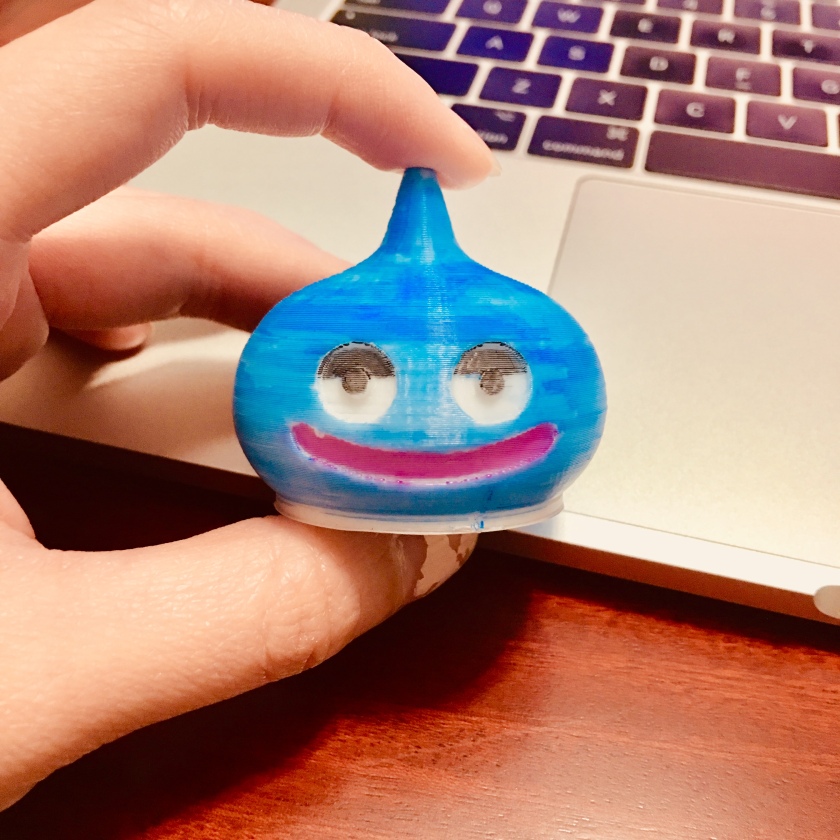
This is a generic slime character from the video game franchise, Dragon Quest. His name is Rocket Slime, and I loved his design from the series. When it came to 3d printing, I was first inspired by bulbous, stackable characters such as Disney’s Tsum Tsums or those stackable stuffed animals. This slime is stackable with other duplicates of it since it has a hole at the bottom. There were drawn parallels to me that if something was small and plastic, it should be a simplistic character which could be holdable. This design easily rests in my palm. I found other slime models and stackable characters on Thingiverse, but none spoke out to me as almost identical. Painting was the most difficult. I did not have any acrylics, but I found out permanent markers went great on any surface including pcl. Also I added eyelids to this character, because I found the muppet-like eyes to be more endearing than the original slime.
There’s really no meaningful reason as to why I choice a pawn to 3D print. It was honestly the first game piece that came to mind when I read the side quest assignment description. I’ve always liked the pawn even if it is technically the weakest piece in most cases. In terms of challenges, I didn’t experience any trouble once the link was provided to look up game pieces. I took it to the Tech lab last Wednesday after I downloaded my .stl file, sent my request in, and the piece was ready within hours. I’ve never done 3D printing before, so this was an interesting experience — and it’s useful to know that we have this type of resource at Emory.