Play Make Write Think

My Childhood Coming to Life

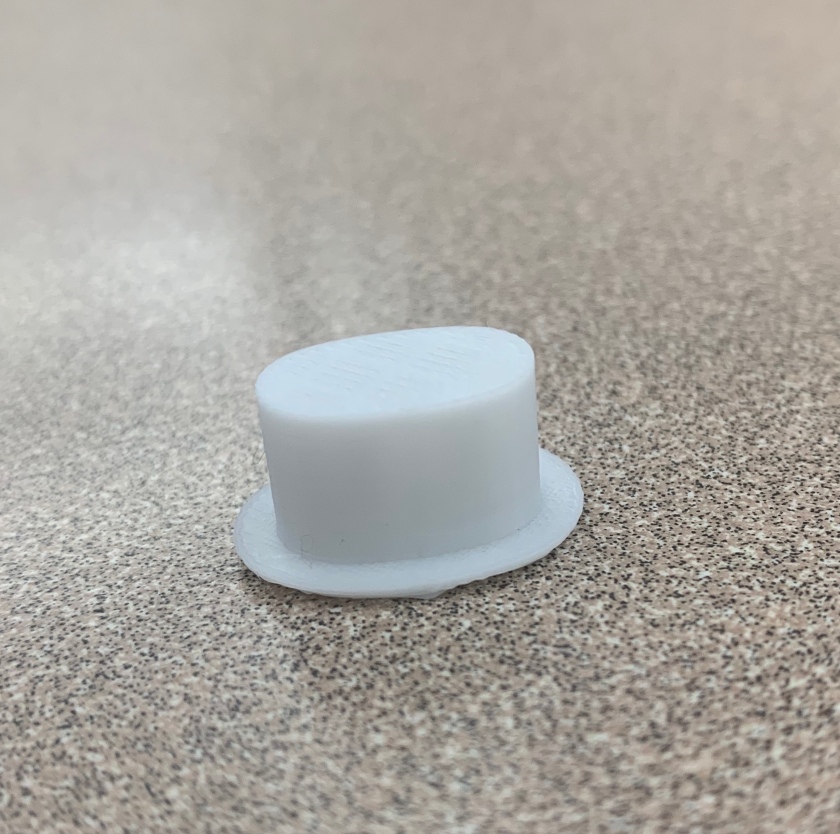
Growing up, Monopoly was an integral part of my family life. Every Friday night, we would sit around the fire and play Monopoly. Although we never finished the game, Monopoly always yielded an exciting evening. For my 3-d printing challenge, I wanted to print something that meant something to me. I scrolled through the websites Professor Morgen linked to online and came across the top hat game piece from Monopoly. This image struck me since I always played as the top hat in Monopoly. I took this image to the Tech Lab, downloaded it, and ran it through the DremelDigiLab 3D Slicer software to make it into a 3-dimensional object. I adjusted the size by making it slightly bigger than the real game piece because the real piece is so small and I wanted something a little more substantial in size. I then chose if I wanted to make the hat black or white, and I chose black. When I came back to pick up my game piece, the hat was bigger than I expected and white instead of black. I was a bit surprised by these varying details, but I was still content with the final product. Even though my hat does not look exactly like the hat on my monopoly game board, I am excited to have a physical piece of my past to carry with me. 

Fiasco Reflection

Fiasco is a cooperative multiplayer role-playing game that generates During Fiasco, our group weaved complicated narratives and challenged each other’s creativity through unexpected narrative switches. Fiasco’s rules and setup encourages innovation by the players. The limiting dice choices and permutations forces players to navigate through unique relationships that might have not been produced without the imposed restrictions.  In addition, the Tilt creates new and different additions to the narrative that must be incorporated. The game of Fiasco makes each player strive for originality, cooperate with other players, and develop critical thinking skills.  

In our individual game, we played with five players for roughly three hours. We told a pseudo-revenge story with each member wanting to “get even with this town for what it has made you into”. My character’s direct relationships were being drug friends and ex-spouses with my two neighbors. As my drug buddy was also the mayor of the town, I adopted a more radical representation of a drug-user and barely spent a minute sober. Consequentially, other’s needs and wants were prioritized over my own as play commenced. I offered comic relief, advanced other’s narratives, and cooperated for the best of the group. At times, I felt like a secondary character being used to push forward the storyline and solve or create a problem. Consequentially, I found enjoyment in trying to be the creative storyteller; whenever it was my turn, I would try to establish an innovative scene. For example, roughly a quarter way through the game, we had been trying to figure out what to do with a briefcase of money and drugs. During my turn, I asked where the briefcase came from and offered some possibilities: divine intervention, the mafia, and a hidden camera game show.  Though we decided that the mafia would be involved, having the options encouraged discussion about where our plot might go. These types of decisions are inherent in the game of Fiasco.  

Fiasco’s structure is unique due to the combination of freedom and structure. Compared to other board games or role-playing games, a significantly larger portion of interactions are set. For example, in first person games on consoles, interactions are prerecorded, but a player has agency to decide which path to choose. In Fiasco, not only are degrees of freedom infinite, but the scenarios are also being created. The guidelines and rulebook act as a primary way of sparking interest rather than forcing players to follow a path. However, Fiasco still provides many of the same functions as traditional boardgames or role-playing games. Much like creative writing, the processes and decision making is very similar; the difference is how much time is allotted to make a decision. In Fiasco, a player must commit to a path directly after being given a scenario. In contrast, one creating a novel or short story could create unbounded permutations of the same story until it’s satisfactory.  

Personally, Fiasco helped me progress by forcing me to step out of my comfort zone. I’ve always acted and been involved in theatre, but with people whom I am comfortable with. I joined the Fiasco group very late and didn’t anything about the group members besides their names. Fiasco challenged me to learn about myself and others through the decisions we made in certain situations. Not only was it very enjoyable, I learned that being the scapegoat can be entertaining and fulfilling; in addition, I also learned about my peers, developed my problem-solving skills, and worked on communication and collaboration with peers. 

#fiasco

20-Sided Dice from 2nd B.C

https://www.metmuseum.org/art/collection/search/551072

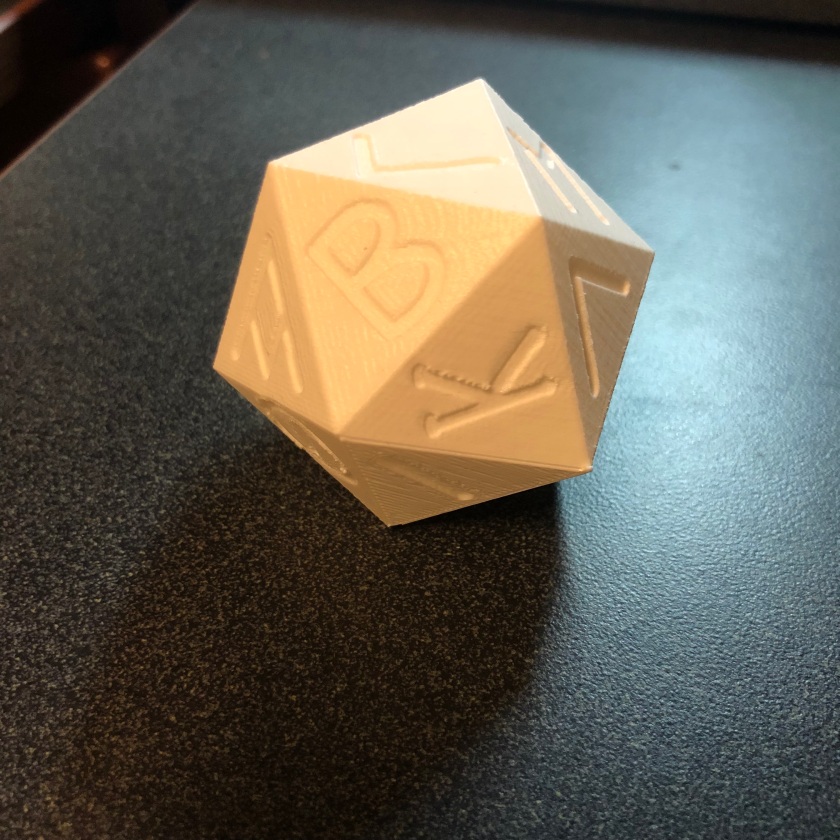
I chose to print this die based on an actual die from Ptolemaic Period–Roman Period, around 2nd century B.C.–4th century A.D. collected in the MET museum. It was said that the simple letters on the die might relate to divination: a Greek oracle book composed in in the 2nd or 3rd century A.D. refers to throwing lots to obtain a number that would, through certain algorithms, lead to ready-prepared oracle questions and responses. I thought this was really interesting: 20-sided die wasn’t invented by Gary Gygax. Google is wrong! (Well, I guess Gygax invented the concept of using it in games, but not the actual object). It would be a good game piece, as it generates tons of randomness and produce a lot more possibilities in games. There wasn’t too much difficulty for me,  but I did spent some good chunk of time scrolling through the websites. I actually enjoyed the “scrolling through website” process, because some of them are really creative and well-designed. Now I just need to color it , not sure how I’ll do it yet. If I have a second chance, I would definitely choose the other material that David used in his post, those ones look a lot more delicate.  

From Computer to Reality

I’ve always wanted to use a 3D printer, and I finally did. I wanted my game piece to smaller, but I wasn’t exactly sure of what I wanted to print. 3D printing is so amazing because it is a process that takes a digital file and literally forms a tangible replica in 3D space. I went onto a site that had many different “things” I could print. I wanted something cute and that somewhat represented me.

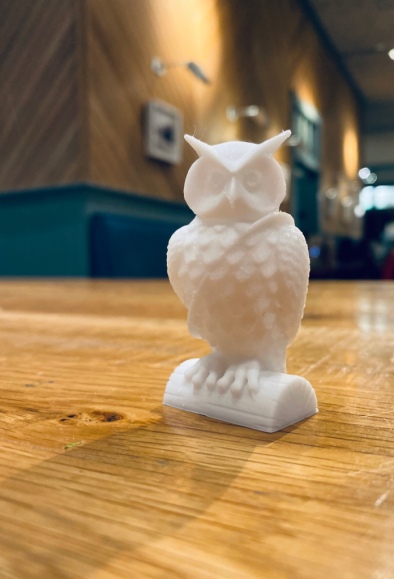
Since my family knows that I want to be an engineer, they have always expected me to use a 3D printer (especially when I got access to one in college). With my family in mind, I turned towards things I knew my mom and sister liked. I am toying with the idea of giving it to them as a gift. Finally I found a section on Harry Potter – something my mom, my sister and I love. What was even better about this find, is that one of my mom and I’s favorite animals is an owl.

I brought to life the Harry Potter mail carrying owl.

Seriously, it’s Batman

I am recently into the Lego DC Super-Villains game, playing monthly with my friends on Switch. Therefore, the game piece that I thought about for the 3D printing project is a Lego toy. Although Batman is not the protagonist in Lego DC Super-Villains, he is an imposing figure in the DC universe, and most importantly, it is almost all in black that could save me time to put on color.

However, unexpectedly, the TechLab mistakingly printed my Batman with the white plastic, and I had to color it by myself. It is hard to paint color on the slippery plastic, and there are unapproachable cracks that don’t take color. After my painting, it is even less persuasive that this 3D printed piece is not a naive Japanese childish cartoon figure whose name I could not recall but Batman.

Podcast Reflection

I began the process for making my podcast with the idea of nostalgia in video games. I thought that revisiting games from my childhood would be a good starting point. My main two ideas for games were Runescape and Minecraft, but since my associate producer Michael never played Runescape, we settled on Minecraft as the better option. After a meeting with Professor Morgen, we decided to shift the focus from nostalgia in Minecraft to explaining and analyzing how Minecraft shaped our values and experiences as kids to us as adults in college. We both decided to play the game again for about an hour to reflect on how the experience has changed. Being the executive producer and having played Minecraft more than Michael, I came up with most of the framework and ideas and wrote some scripted parts before we met to record and discuss the game.

Our primary goals of the podcast were to address how Minecraft has affected us as kids, the relationships that were formed around the game, and the affect of playing the game again with these nostalgic memories. We had this framework before we started recording, but we also wanted to unscripted moments and conversations between the two of us. To get through the unscripted portions, we wrote bullet points of different topics we needed to cover as we talked and we went from there. I made a podcast with audacity before in senior year of high school, so fortunately I already had an idea of how it worked. I could cut, stop, and go as we went along going over our primary goals. At certain times we weren’t confident in our unscripted moments, so we recollected our thoughts, thought of new ideas, and tried again. Overall, the recording process went pretty smoothly, as did most of the editing process. I decided to do the editing because I had the most important position and Michael had a lot of work. I found an artist on Free Music Archive that I liked, so I just used his music. The rest of the editing consisted of sound mixing and deleting the “um”s and awkward silences between takes.

By making the podcast I was able to compose a form of English utilizing modes. The first was a scripted introduction, conclusion and description of the game, and the other was transforming that writing and outline into unscripted verbal communication with another person while arguing its beneficial effects to convince an audience. I was also able to summarize and conclude my arguments succinctly in my conclusion. After meeting with Professor Morgen, I revised my main thesis from being analyzing nostalgia to analyzing the effects of Minecraft on myself and Michael from past to present. I utilized the Yeti microphones in the library, reserved a private room to make sure there were no outside noises, and enhanced the podcast with Creative Commons music. Making this podcast improved my skills with verbal communication, technology as a form of media, and revision of work as a way to create a new, strengthened, product.

The Gam3D Life

I decided to 3D print a car game piece from The Game of Life. I settled on this piece because I didn’t want to just choose one of the default game pieces that you provided us, so I went searching on Thingiverse. I immediately went through all the different board games I played as a kid, and The Game of Life was one of my favorites because it was more complex than Candyland, and I wouldn’t always lose to my brother like I would if I played Monopoly. Luckily, someone had already made an .stl file for car game pieces, so I chose it. Each car has multiple holes that you fill up with SOs and kids as you move on in the game. I also found the game fun because I was introduced to adult concepts at a young age, even though I never grasped them entirely. Luckily, I went with Michael to make it early and the people at the TechLab were very helpful so I had very little trouble making the piece. Although it has that “3D print feel”, I’m happy that I made something from scratch and the final result turned out well.

A Very Impressive Train

As you can see, I 3D printed the locomotive piece from monopoly. I’ve always loved monopoly, and when I was looking through the linked game pieces I picked the train because I found it to be the most intricate. In a way, I wanted to test the 3d printing center and see how accurate their printing of such a small train would be. I didn’t have much trouble getting it printed; I just gave them the file and let them work their magic. Quite frankly, I find 3D printing really interesting and wish I was more involved in the process. The only issue I ran into was being too low on Eagle Dollars when they asked me to pay. I spent 5 embarrassing minutes of silence at the woman’s register before I finally figured out how to replenish my balance. They printed the piece with more detail than I had expected, so this side quest was a success.

Fiasco: my thoughts

By Rachel Vellanikaran

Playing Fiasco was quite an interesting experience, to say the least. With some initial difficulty figuring out game-play and rules, we eventually rolled the dice to establish various relationships, needs, objects, and a location. This initial process of deciding these contextual aspects was a little different from the last time we played in class, as this time we actually selected dice before reading the category and descriptions — adding to that surprise factor that’s so prevalent in this game. My fellow teammates, Austin, Cherie, Sadie, Giovanni, and I chose to play with the Main Playset. Taken place in Hickory Smokes “nursing home,” our narrative included multiple adulterous sexual affairs, backstabbing, murder, and more. My relationships included a friendship with Giovanni as a “manipulator” of some sorts, and co-worker of Sadie, non-coincidentally at this particular nursing home. The narrative started out with Austin and Cherie fighting over financial issues in their marriage, and Austin eventually kicking Cherie out of the house. One of our two needs was to get laid, and with the other need already utilized by another team member, I chose to incorporate this into my narrative. My character was working towards a sexual relationship with the newly-divorced Austin, and would take some deceptive measures to do so. Conveniently, Sadie, a fellow colleague of ten years, was friends with Cherie and Austin and thus my way in. The story continued to take creative and unexpected turns throughout our game-play, from Austin and Giovanni’s conspiracy to murder Austin’s grandmother’s best friend to Cherie acquiring loads of money through her gambling habits to my character’s affair with the divorcee who was simultaneously trying to kill and steal from the elderly woman at the nursing home. It was absolute chaos, but quite fun, nonetheless. 

It was particularly interesting to see how events change so drastically before you even realize it. This game is based on your own creativity when it comes to establishing and resolving scenes. You, yourself create the narrative and can manipulate it for better or for worse. I didn’t realize how open-ended and flexible the game design is, where you(and your teammates) create the basis of a story and see how it plays out. Because it was truly up to improvisation and our imagination, as I said before, it got a little chaotic. For example, at one point the hoodlum murders the old lady in front of me, the unsuspecting, innocent nurse, and I decide to cover up for him and end up in jail — where I eventually kill myself. It was a lot…but it was actually very enjoyable to see how everything played out as we all added new twists to the story.  The game design itself does have certain guidelines and rules, but it doesn’t really limit your ability to, for the most part, change the narrative as you wish — at least until the very end where they add in “the tilt.” My tilt was a little out of place for the situation of my character. The description was basically along the lines of “you f**ked up hard; you’re probably going to kill yourself,” when I truly hadn’t had much involvement in major conflict up until then. So from then on, I had to come up with creative ways to set-up this ending for my character — even if it meant some far-fetched additions.

Admittedly, playing the game seemed a little intimidating at first, since I was playing with new people and felt pressure to conjure up captivating story-lines and premises. But, obviously these initial apprehensions subsided as we continued to play. Since much of the the game is about “winning” role-playing situations and acquiring dice, I found myself being a little more assertive or defensive in my responses to others as I took on the role of my character more seriously with the game’s progression. It was important to be strategic in the stories you created. You had to manipulate the situations created by others in favor of your own plot or chosen line of fate. It required a bit of planning, particularly in predicting how others would react and respond. Overall, playing Fiasco was a rewarding experience, as the game was captivating and enjoyable despite its natural chaos and unpredictability. 
Risk Podcast Reflection

I, along with Will and Sadie, recently completed a podcast on analyzing the game titled Risk (https://eng101s20.davidmorgen.org/ready-set-game/risky-business-a-deep-dive-into-the-game-of-risk/). Due to the tremendous strategy the game requires in order to win, it has always been a favorite of mine to play. Risk requires a lot of critical thinking, so playing is always a challenge I look forward to. Considering my thorough enjoyment for the game, I thought it would be fun to review it in a podcast. Since we were just a three person group, we collaborated for every part of it.

The theme and style of the background music was something we decided to adapt from previous podcasts. We initially had some trouble determining what style of music would work well with what we were creating. It can be difficult to choose a sound that compliments the voices speaking, but also isn’t distracting. After listening to past podcasts, we realized a calm but playful track would fit well. In addition, only being able to explain concepts verbally caused us some issues. I never realized how reliant I was on visual aid until having to explain Risk without any. For instance, there was a point where we wanted to demonstrate the exponential relationship between the amount of land the player has and their power in the game. A graph or hand motion would have demonstrated this well, but instead we had to put it into words and hope our audience would understand. 

Our primary goal in creating the podcast was to keep the audience engaged. In order to keep it interesting, we attempted at finding the right balance between talking about the history of the game, its relevance and meaning to the world, and strategy within the game itself. We found this balance by making connections within all of our information. For instance, we tried to make the meaning of the game transition and connect to different strategies players could employ. Along with frequent transitions to prevent boring the audience, the connections made the podcast easy to follow and compelling. 

Intuitively, one would think that writing in the form of a conversation between people would come easily since everyone converses. I realized while writing the script that recreating conversation is pretty difficult.  After we finished the script, I noticed that it sounded a lot less like a conversation than I was expecting. This was presumably due to my experience in writing being purely formal or scholarly. When writing my next podcast, I’m going to try to be more conscious of how conversational it sounds in order to make it more engaging for the listener.

css.php