Play Make Write Think

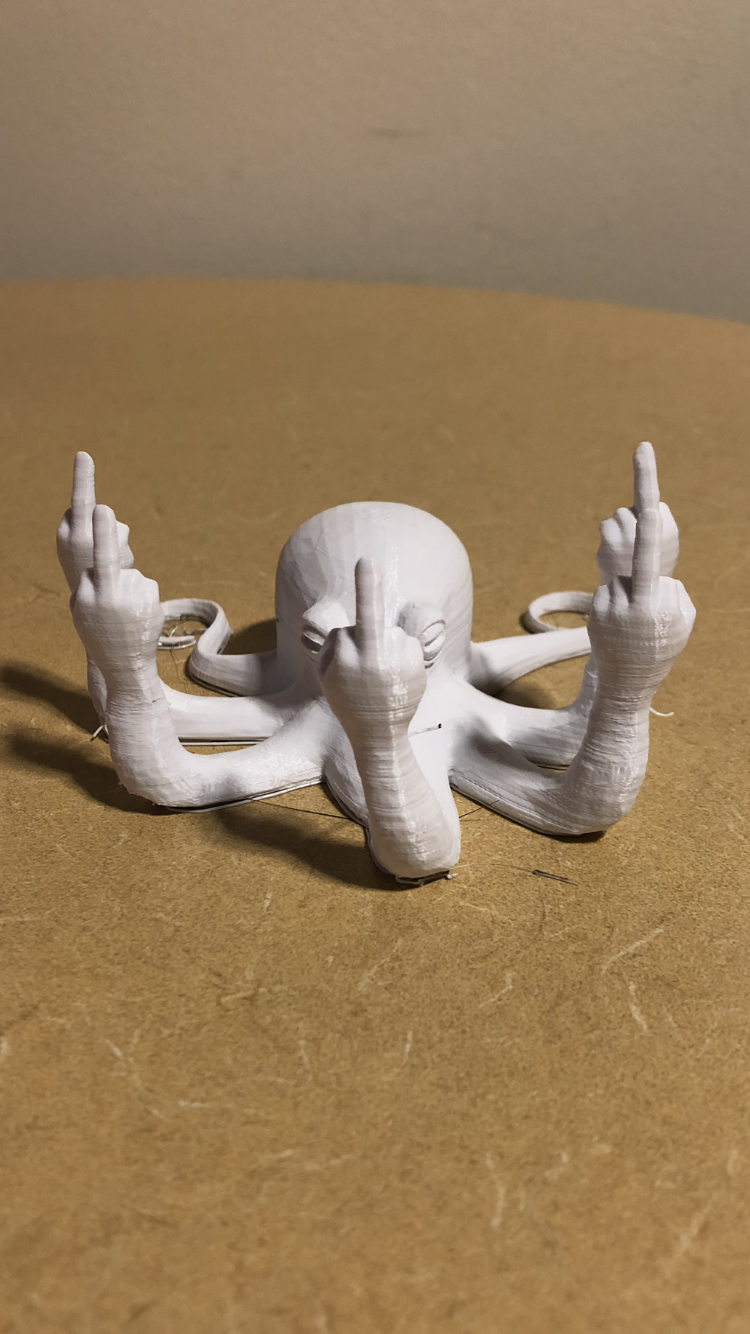
Fucktopus

I had been searching Thingiverse for what seemed an eternity, I was beginning to lose hope. ‘Maybe I’ll have to settle for something boring like a chess piece or die’, I dispaired. It was then that I was struck by this masterpiece, designed by the man, myth and legend that is MasterFX a.k.a. Timmo. It’s difficult to articulate why this 3D model appeals to me so much, I just knew it was the one the second I laid eyes on it. My fucktopus will forever be a feature on my desk.

On a slight side note, the TechLab was incredible. I feel so lucky to be at a college with such amazing facilities. I will definitely be taking advantage of it in the future.

Fiasco: Off the rails, but on track

My group’s game session of Fiasco was an entertaining, creative, and thought-provoking experience. My name in the story was Edward Anderson, Winslow’s was Collin Anderson, and Greg’s was Russell Cooper. The game required us to make many choices that turned out to be the framework of the story. For example, our story was set in the wild west because we chose the Boomtown set. We then formed relationships with each other by rolling dice. I was Collin’s parent and Russell and I were former lovers. We then rolled the rest of the dice and figured out that we needed to get rich through robbing a business using a railroad hand car at boot hill across the tracks. 

The story we told was based off Russell and Collin’s relationship as gambling partners who are being chased for money. The game started slow as we were trying to develop storylines and follow directions properly. My group decided that to get rich, we needed to carry out a heist. This helped guide the plot and we added details and threw in twists in every scene in preparation for the big heist. For example, I was part of the mission to get back with Collin rather than get money. This may seem like a minor detail, but it was noticeable in the second act when sacrifices and choices were made to resolve situations. More details allowed players to understand everyone’s personality, interests, and motives. However, we all put our individual interests aside and worked as a team to prevent a train from going through boot hill and retrieve the $1 million dollars that was on board the train. 

The tilt happened when we were escaping with from police with money. The tilts suggested that everyone dies in the second act except for Edward. This added a new challenge because every player needed to incorporate their tilt at some point, and we did not know when that would happen. This forced resolvers to think on their feet and continue to drive the plot. In the end, Russell was shot on the handcar because he saved Edward, his ex-lover, from getting hit. This left only the father-son duo of Edward and Collin remaining. Collin died from a gunshot wound and Edward killed himself in a shootout with the police because he thought the two people he cared about died. However, Russell was still alive.

Overall, I was expecting the game to be more structured, but I was pleasantly surprised with the flow of the game. We were able to make the game more fun and less stressful because of looser rules. Each of us had moments where we drove the plots forward and sat back and reacted to what others did because of the roles chosen at the beginning of each scene. Our roles varied throughout the game, so everybody contributed by adding details or bringing the story back to our objectives. The learning outcomes that were fulfilled while playing Fiasco were rhetorical composition and collaboration. Fiasco was a new type of game to me because it required us to create our character and story rather than having structured guidelines. In these roles, all players collaborated and communicated clearly with each other to add to the story and work towards our group goal of getting rich. 

I believe the skills and strategies I used during gameplay were effective because I was one of the last characters remaining. Playing Fiasco showed me that I could improve on thinking quickly in an uncertain situation. For example, there were times when it took time to think of a reply. I can improve on this in other games we play this semester and on future assignments by pushing my boundaries and taking extra time to get my creative juices flowing. The more creative I get, the easier it becomes for me to think of a response and improve my reaction skills.

I am proud of the Fiasco story my group created. It took a lot of teamwork and collaboration to form a story that flowed and integrated all our objectives. In my opinion, we successfully did that. This was my first experience playing a role-playing game. The most interesting part of forming the story was trying to resolve each scene after the establisher. It was much more challenging than I anticipated, but it was overall enjoyable and showed me that I am more creative than I give myself credit for. 

Link: https://www.pxfuel.com/en/free-photo-okqix

Many a Little Makes a Mickle

In our Fiasco group, we chose the setting as Main Street, and my alias was Molly who was a former spouse of Yeezy and had my father named Joseph. My key location was a durable paper goods, paper bag manufacturing plant out by the interstate. In our story, we had drug friends, thieves, and gamblers. In the beginning, thieves named Yeezy and Robert were talking about the recent activities. According to Robert, Yeezy had not robbed recently and wanted to quit her job as a robber. Although Robert was upset about her thought, they promised the final project which ended up failing: Yeezy pushed off Robert from the bus and Robert got caught. All the problems started here. Also, the gambling was held in the basement of the Mexican restaurant in the Main Street, and the reward for the victory was a suitcase. No one knew what was in the suitcase, but gamblers and thieves expected something precious inside, but as the story moved on, we found out that Yeezy stole the suitcase, and inside the case, there were two kilos of cocaine. In act 2, other characters other than me got panicked; they tried to become rich. As the rumor about the suitcase spread, everyone tried to steal the suitcase. Interestingly, in the end, Joseph was able to get the suitcase, while Robert, Yeezy, and Kyliej were killed. Although he owned a stone material store which was pretty successful, he still needed to support his son. Inside the suitcase that had kilos of cocaine, there was a poisonous snake inside the suitcase, and Joseph got killed by the snake. We do not know whether this was an assassination plan contrived by Yeezy. In act 3, because of my father’s unexpected death, I obtained the suitcase full of cocaine and became a cocaine addict.

Overall, I thought the story was messed up. The main reason was that we had many irrelevant items that we had to use. In the beginning, we were trying to find out what was going on. For example, we thought that Yeezy was a good character because she said that she was going to quit robbing. However, as the story moved on, she became the worst betrayer. For my part, I could not do anything dirty because I acted like a normal person (although I planned to kill Yeezy who threatened me that she was going to kill me later in the story). Therefore, I could not make my character interesting. As the story moved on, I liked how new items were introduced, which became the key items in the story. For example, the suitcase was the main factor to start the conflict. Somehow, I, who had the least amount of greed, obtained the suitcase. If every story needs a theme, then human greed will destroy his or her life. This is literally fiasco. At the beginning of this paragraph, I said that the story was messed up but this fact does not mean the story itself was terrible. After playing this game, I realized that this world is actually as random as the story we had. The randomness introduced by the subtle differences in plans among the players makes the setting chaotic. In reality, we also have subtle differences in our thoughts, and when those differences accumulate enough, they eventually lead to major conflicts.

Fiasco Reflection

We played the game Fiasco on Sunday. The setting of our game was Main Street. During the phase of setting up, we tried picking relationships and details that are crime-related, such as drug friends, thieves, gamblers, and crushing debt. We tried to brainstorm our big picture and some small details as we sort out dice to choose the details so that, at the very least, our story will make sense. However, as our choices get more and more narrow, we had to pick details that seem completely unrelated to the plot such as a stone material shop and paper plant; in addition, the rule book had some add-ons for a five-player game, in our case, was a poisonous snake. Unexpected add-ons details definitely increased the difficulty of our game, especially when we had our storyline settled along the way, which allows less room for flexibility, but how can this game be fun without some randomness and surprises?

It was definitely difficult for us to start the game because there is not an official “start” of the story; however, after the first scene, which lays out some details and backgrounds for the rest of the players to play around with, everything became easier. The game proceeds in a form of conversation between two players, personally, I tried my best to mimic the tone and word choices my character would have in order to help myself, as well as the rest of the players, to bring themselves into the story. The favorite part of this game for me was that even though all of us were aware of the general direction of the story, we always generate new thoughts and details as the story goes, especially when you hide your intentions from the rest of the player, that’s where things got interesting. My character is both a drug addict and gambler. To push the plot, I incorporated an item that was not on the detail list but can be important–a suitcase. Since I’m a drug addict and a gambler, my original idea was that I will partner up with my gambler friend, Joseph, head to a underground Casino located in a Mexican restaurant in Chinatown, and Joseph can use his terrific gambling tricks to help me win the suitcase from a guy called O’Brien (a character I made up), and things can go from there.

After the establishment of this new item, it somehow became the center of the whole story, everyone was going for the suitcase, especially when Yeezy (another character who is a thief) established a scene with her thief friend, telling her she somehow stole the suitcase from O’Brien, which completely changed the plans I had in mind–I had to brainstorm and think of what to do next in order to adapt to the new situation.

I think the heart of this game is the unexpectedness and randomness, such as the ability for different players to alter the storyline during their turns and the Tilt in the middle of the game, that is when I started putting myself into my character, and think about what I will actually do if I was the character who is in the situation. The fun part of this game is that everyone turned into someone else, and just “play” the character in a totally dynamic, corrupted situation; everyone tried to reveal as much as their “dark side” possible by purposely incorporating sinister elements and foreshadowing the incoming traumatic events. In short, no body wanted anything good to happen to anyone except for themselves. At the end, we purposely created a tragic ending by having almost everyone died, except for one person who became a drug addict, which, in our case, was the best ending possible.

Despite how disastrous the plot was, Fiasco was indeed a better form of stimulating creativity than traditional writing: the interaction among player, the various thoughts and opinions, and most importantly, the synchronization between the players and the characters they created, generates an effect in creativity that traditional writing cannot achieve.

Random Thoughts

The experience of playing Fiasco brings the memories of Beginning Theater classes back to me. The improvisation games are much simpler then, of course. Every student in the class says one word to a one-minute dialogue, depending on the rules, and together the whole class tells a story. No matter the number of words a student gets to say or the size of the class, the goal remains to keep the story flowing. Those games were much more lighthearted than Fiasco, but the mechanisms of the two resemble each other. The winner in Fiasco does not have to be only the ones who survive and get away with the prize. The entire group of players could win when it narrates a logical and intriguing story together. 

The discussion part of Fiasco makes the storytelling collaborative, so it becomes every player’s duty to consider whether the story flows smoothly. It tends to be challenging to accurately portray a character, especially when he/she is of a different gender. In addition, to truly be able to think and act as another person takes much longer than half an hour. Questions from where did the character grow up to the character’s favorite song could be considered to bring him/her to life. Limited time means players may not have perfectly adapted to the character, so discussion becomes crucial. When a player plans something completely out of character, others could suggest a more logical action. 

In addition to discussion, the acting, or improvised dialogues scenes, are collaborative. As in improvisation theater, “Yes! And?” serves as an important rule. You do not tell your fellow actor “No, that did not happen,” while they act. In Fiasco, you can disagree during the discussion or add in new information to twist the story, so long as it fits in logically. When a player makes a decision during the act, however, the rest of the group follows. They could discuss before the decision is made, but once it sets, it sets. Although the players adopt characters (deterministic laws), each of the players (five in my case) can still act unexpectedly (randomness). You don’t know what other players have in mind. They can give you a dice of the opposite color to the one you had in mind, or add in information that leaves you in an unanticipated situation. Sometimes a decision might subvert the whole plot; yet, if other players halts the course of acting by saying “no,” part of the fun in the game is lost. Also, the design of Fiasco doesn’t ensure a good ending, or winning, of a character even if he/she remains alive at the end of Act II. A dice roll could still lead to a bad ending. 

During our gameplay, I was the one that attempted to subvert the plot. At the beginning of the game, Robert (Kathy) and Easi (that’s me) planned to steal some cargo (2 kilograms of high-tier cocaine) from a source. Then, after the rest of my group planned on obtaining a case with unknown, valuable content from a Mexican restaurant, I revealed that the case they were after was the one already stolen by me the night before. The other players decided to follow my narration, and I became targeted by three players immediately. As the plot unravels, four players began calculating each other to gain the lion’s share of the cocaine. We made plans, and the tilt happened. Surprisingly, it fitted well into the narration. Someone panicked, and someone died. After discussion, we decided that Robert was the most likely to panic, as he was under stress from his family (his mother going through chemotherapy), a debt coming due, haunting memories and hatred towards his thief partner Easi. Joseph (Alan) catalyzed the process by revealing that his goal amidst the chaos was to protect his son Molly (Keita), get rich, while staying clean. This way, him leaking his employee Robert and partner Kylie’s (Ruohan) plan to their target Easi was justified. In the end, Kylie, Easi and Robert all died, and the case with cocaine fell into Joseph’s hands. However, a poisonous snake was set up in the case for whoever took the case from Easi, so the snake killed Joseph, too. 

It is fun to stay alive in Fiasco. However, the equally entertaining part is to tell an engaging and logical story. As in classic noir films, some characters are destined to die. The protagonists are designed incapable of resisting the charm of the femme fatale and the lure of social mobility, while the femme fatale plays to her own downfall. A film may be successful with the protagonist and antagonist both dead, as Fiasco could tell a successful story with no individual victory.

Sidequest 7: “You’ll never catch me, I’m the gingerbread man”

My printed game piece
Actual Candyland game pieces

The game piece I chose to make using the 3D printer at the TechLab was the gingerbread man from the board game Candy Land. I brought in my .stl file Tuesday evening and picked up my piece on Friday afternoon. The process was very straightforward for me. I went into the lab with my file saved to my computer and they put it on a flash drive and asked me details of how I wanted it to come out.

I chose to print a game piece from Candy Land because that was me and my sister’s go-to game when we were bored at home. I was talking to my younger sister earlier that day and that’s when the idea came to my head. The piece came out exactly as I imagined it would with every detail mimicking the actual game pieces. In the actual game set, the gingerbread men are colored and this one wasn’t, but I will definitely bring it home to add to the set.

The process was very straightforward and I was in-and-out of the TechLab within 10 minutes. I had no idea one of my friends worked there, so I asked about other programs and machines they have for students to use which was very interesting. For example, I learned they have workshops a couple times a month relating to technology and engineering. I had never utilized this resource on campus, but it is definitely helpful to have if I ever need to construct something complex.

Links: https://flic.kr/p/dujTtt, https://eng101s20.davidmorgen.org/quests/side-quests/side-quest-7-3d-print-a-game-piece/

Fiasco Fanatics

Game Details: Boomtown

My name: Collin Anderson

Greg’s name: Russell Cooper

Michael’s name: Edward Anderson

My relationship with Russell: both gamblers

My relationship with Edward: son of Edward

Edward and Russell’s relationship: former lovers

Need: to get rich through robbing a business

Object: railroad handcar

Location: across the tracks – boot hill

Tilt:

Russell: Tragedy – pain followed by confusion

Collin: Guilt – greed leads to killing

Edward: Innocence: a neighbor wanders into the situation

The first time playing Fiasco was difficult; before starting, I didn’t realize that the vast majority of the roleplaying was created entirely from the players. I thought there would be much more structure, but I found out the beginning framework that we completed in class was essentially everything we were given to work with. I played with Michael and Greg on Tuesday after class, and after setting up the relationships, needs, objects, etc., we initially found it very difficult to create a scene from scratch. Instead, we first came up with a main overarching plot that our story could follow, giving us a sense of direction and something to work towards. Given our starting setup, we came up with a plot that follows: Collin (me) and Russell (Greg) are a pair of unsuccessful gamblers in the late 19th century who lost a few bets too many, and now a gang of loan sharks are after them. They come up with a plan to repay the loan sharks by stealing gold from a train, recruiting the help of Collin’s dad, Edward (Michael). They wait at Boot Hill outside town and strike once they see the train. The robbery is successful at first, but things get complicated from there.

Given a plot to follow, creating scenes came much more easily. For the most part, we decided to create our own scenes to give us more control of our own characters. In my scenes in particular, I tried to develop the emotional strengths and weaknesses of my character: in my first scene, I described my ethical dilemma towards my gambling addiction, and how it was fueling my worst behavior and causing me stress. I also described the anxiety of being indebted to bloodthirsty loan sharks, and how that was driving the conflict for my character. Everytime we drew a white or black die at the end of each scene, we would describe a good or bad thing that happened at the end of the scene, such as Russell getting beat up by loan sharks and given a week ultimatum to repay his debts. For much of Act 1, we spent our scenes developing the reasons and desperation that led us to plan such a large-scale robbery. When Greg and Michael ran out of ideas for their scenes, I would offer alternative solutions for ways to advance the plot in a way that made sense. For example, in order to get Edward into the robbery, I decided to frame it as a way for Edward to reconcile with his former lover, Russell, and to show him he still cared. The robbery was a success, and as we made our getaway on the railroad handcar, the tilt began.

Given our tilt rolls, we knew at least one of us was bound to die. I could feel the pace of the storytelling accelerating as the climax unfolded: we started speaking quicker and bouncing ideas off each other with much more fluidity. It ended with the betrayal and the death of Collin, and Edward also died in a shootout with the police.

Writing about Fiasco stressed my critical thinking and reading resulting in writing by making me summarize and analyze our long, 2.5 hour session in less than 700 words. As we were acting out the scenes, we wrote down the details of each scene into a google doc, although I found out as I wrote my reflection that it was impossible to write all the details I wanted while also including my thoughts and reflecting on the game. This reflection was also writing as a process which made me revise and rethink the way I wanted to convey my thoughts succinctly. Collaborating with my peers was also a fun exercise, and we got to know each other better as we created a story together. Overall, the experience was positive for me and I got to create my own story in more detail than I’ve ever done before. The reflection also helped me format my writing in interesting ways that I would have never been allowed to do in high school. Fiasco effectively fostered creativity and a collaborative environment, making a fun and constructive game for all to play.

After The First Time Podcasting…

First, I will explain what we did for our project. Then, I will comment on our product and discuss what we can do to improve the quality of our piece. Finally, I will chat about how this project affected me.

Our main goal of this podcast was to make natural, just like a conversation between two people. First, we made a framework of the podcast about the League of Legends, using Google Docs. This framework was done by bullet-pointing topics that we were going to discuss. Then, we looked for resources we could use for our project. The main producer interviewed an experienced player, and we looked for suitable pieces of background music. Then, we started taking voice recordings.

The first impression or feeling I had towards our piece after podcasting is unsatisfactory. As Professor Morgen told us, I was stressed by voice (mostly because of my accent and fluency). However, these problems cannot be resolved in a brief time. Therefore, what I can do for the future is to imagine many kinds of scenarios and organize my thoughts for each scenario so that at least I can speak fluently and this fluency can make listeners more comfortable. The second improvement we can make is preparation for podcasting. We, the producer and the assistant producer should first play together so that we can share our opinions about the game before we start podcasting. This preparation should work as a “practice round” for the podcast. When we share our opinions, we can add some important aspects that can relate to the broader medium and eliminate topics that take too much time, which can make listeners bored, and topics that are hard for listeners to understand. Overall, I found many places that we can improve on, so we will make use of these failures for the next podcast. Our goal will be to make our piece more smooth and interesting. If this goal is reached quickly, then we can work on the naturality.

Although I only talked about the negative side of our product, I also have a positive attitude towards this project. I was glad that I was able to experience podcasting (I enjoyed taking podcast). Although I am a person who does not talk in front of people, this project forces me to speak and I could feel that I was getting used to speaking. Interestingly, I am looking forward to making the new podcast episode.

Bookies, Druggies, Dead Babies >> Fiasco Game Reflection

Fiasco offered an experience full of tantalizing objects, needs, and people in the hands of a few dice and an online guidebook. This was a difficult session amongst the five players who played; one was replaced with another player, ultimately changing the social dynamics from the start. The frozen tundra pre-set game changed into a small-town scenario game. Primarily, the game relied on social relations and creativity. Immersion of this roleplaying game similar to Dungeons & Dragons required a re-telling of a story and its characters. Thus, the interactions and acting of the group led to a verbal form of text that followed conventions of writing techniques and referencing outer resources.

The session began with five players in a small town using “Main Street”. Five relationships were in play: bookie/gambler, former spouses, cousins, commissioner/mayor, and drug buddies. I took on the role of a young male office worker unlucky with women and was divorced to an older woman. Will was the former spouse and druggie, Shiela. Zamirah was the cousin and bookie, Z. Some inspiration transpired from Tabletop’s Youtube episode on Fiasco, and I was surprised to find similar relations from a previous session. Act 1 adopted slow build-up due to reorientation of players and scenario: five people in estranged, manipulative relationships try to get rich or get revenge for their fates. Rough drafts were significant in this portion as we would often revise how the story goes when the collaborative effort of the group explores down a narrative path. For example: Nate and Sheila dying from suicide generated and explored two possible endings as a group; discussion chose one. The constraints-the number of dice deciding relationships-led to a focus on relationships between players left and right of themselves. Thus, I found limited interactivity such as my character Nate not meeting Commissioner Jordan till the end of Act 2. The initial setting in Act 1 felt forceful as it occurred under the purpose and audience expectation of creating an under-ground crime hub in a small town with the mystery/tragedy genre.

The story unfolds slowly, starting with my cousin Z and Commissioner Jordan playing bookie and gambler. A mysterious suitcase comes in with drugs and money which from the start involved the mayor and Sheila in the majority of Act 1; all 4 meet up with a personal agenda, strike deals, and double cross others. A secondary narrative was created, because group criticism revealed slow progression due to the writing convention of narrative introduction. I was most active in the secondary where estranged divorcees Nate and Sheila deal with a dead baby, drugs, and an introduction of the mayor potentially having an affair with her. Initial build-up of character was determined at the beginning of the “Set-up”; thus, I went for the pitiful divorcee wanting his ex-spouse back and pulled much of the darker elements as the story transitions from mystery into tragedy. The naivety and pitifulness of Nate gave me a tragic role which supported the group collaboration of tragedy/mystery as Nate gets pulled into the fiasco by Sheila, manipulated by his cousin Z, and killed the mayor in revenge. The group has a habit of pre-determining outcomes in spite of limitations like dice, so I was not surprised by Nate’s eventual insanity. However, the purpose of the game changed due to the constraints. Act 2 invoked a hurriedness to elevate the tragedy; description transformed into acting and improvisation. As an audience member and player, the purpose changed to maximize tragedy for entertainment which required constant discussion in establishing one’s own scene and reference to the guide for endings. I found acting quite immersive with the finale of all 5 characters at a stand-off gun fight while yelling.

Ultimately, the set-up of Fiasco with its stages of “Set-up, Acts, and Aftermath” took on a literary form with our version of a slow introduction, a build-up of exposition through mystery to tragedy, and a twist ending where Nate received the “pretty good” ending, coming out forgiven in society, recovering from mental trauma with a caretaker, living as a hermit. The others included: Mayor Morris died with his grave desecrated (“horrible” end), Shiela locked up in an insane asylum (“savage” end), Z escaped with barely any fortune (not too shabby end), and Commissioner Jordan arrested and wounded (“bitter” end). References during the game session were the online guidebook and Youtube gameplay. The collaboration and editing of scenes after criticism of pacing were important. Given these points, the skills to build a Fiasco game allowed for the complexity of a collaborative and thoroughly explored literary work within the confines of a tabletop game.

LINK: https://eng101s20.davidmorgen.org/quests/fiasco/

THE MAYOR DIED BUT THE BOOKIE LIVED…

Yes. This was my experience of Fiasco. The mayor died, but the bookie lived. How can that be? Doesn’t the mayor have more power? Does the bookie even have a life besides gambling and losing money? Since when were bookies more successful than mayors?! Well, of course in reality, this is unlikely to occur, but in Fiasco, anything can happen. During my experience, my co-players and I decided to create a story with tons of drama. It started off with a bookie/gambler relationship. The gambler (named Jordan) was also a commissioner that worked closely with the mayor (named Johnston), Johnston was a drug friend of a 52 year-old woman (named Shiela), Shiela was the former spouse of a 37 year-old male (named Nate), and the bookie (named Zee) was the cousin of Nate. Our story takes place in an abandoned roadhouse in Main Street, where all the characters attempt to become rich through the discovery of a suitcase full of cash and get back at the city for what it has turned them into. While some were highly successful and others tragically fell, all players used the techniques of probing and telescoping in order to turn the story in their favor.

Our story explored the world of corruption. In summary, all of the players tried to gain more power through money. Through alliances and betrayals, some people were successful in the story while many others were not. It all started with the discovery of a suitcase full of cash and drugs. Everyone besides the former spouse, Nate, wanted in and did what ever necessary to get some of the profit. The climax started when druggie Shiela recognized that her former spouse, Nate, has a newborn, and because of her obsession with Nate and abuse of drugs, she steals Nate’s baby, ultimately killing it. The bookie, Zee, hears about it and then realizes that this was her grand opportunity. Zee recently found out about the stash and that her gambler, Jordan, has been keeping it a secret from her for so long, and wanted revenge, and was going to use her cousin, Nate, to do it. Zee also finds out from Shiela that the mayor sent her to kill Zee for knowing about the stash of money. Zee then wanted revenge on everyone. She wanted revenge on Jordan for betraying her by keeping stash a secret from her, the mayor for his corruption, and Shiela for killing her cousin’s baby. So, Zee and Shiela crosses the mayor and makes a plan to take down the mayor and the commissioner (also Zee’s gambler). Not forgetting that Shiela killed her cousin’s baby, Zee contacts her cousin, Nate, and lets him in on the plan so he can finally get his revenge on Shiela. This is when the climax peaks. Mayor Johnston, Bookie Zee, Commissioner Jordan, and Druggie Shiela all met at the abandoned roadhouse. Zee pretends to be dead so that the mayor thinks that Shiela carried out his hit, but quickly realizes there is no bullet and realizes he has been crossed. Shiela points the gun at the mayor demanding the money and then Nate pops up at the roadhouse, completely insane. He is shaking furiously as he finally sees Shiela. Shiela begs him not to kill her, while the mayor makes smart remarks. The game reaches the tilt. Fed up and so unstable, Nate shoots the mayor in his head, killing him. The commissioner begins screaming and Nate shoots her in her knee cap. Immediately the commissioner recognizes her vulnerability and calls in for backup. Shiela is still pleading for Nate to not kill him, and Nate, although hateful of Shiela, cannot work himself to kill her. Suddenly, the troops come in. The game reaches the aftermath. The story ends with Bookie Zee escaping the troops, and found a stash of drugs hidden in the attic of the roadhouse; she takes off on a dirt-bike. Both Druggie Shiela and Nate were captured by the troops; Shiela gets sentenced to 25 years in prison for drug dealing and use while Nate is acquitted of killing the mayor and has to go into mental institution as the courts found sympathy due to the death of her baby, and later becomes a successful caretaker. Mayor Johnston has a funeral where people cheer and honor him, but soon is exposed for his corruption and dealings with the cartel, resulting in his grave to be dug up, people to go after his daughter, and his name is wiped from history books. Finally, Commissioner Jordan is no longer protected by her troops as they realize her ties to the corrupt mayor and discovery of the illegal cash and drugs within the suitcase upon their arrival to the roadhouse.

I played Bookie Zee, the most successful character in the story. As I played Fiasco, I found ways to manipulate the story into my favor so that I was the most successful. At first, I thought my player had no chance to succeed the goal because the other players had strong alliances to one another and significant power, causing me to feel pessimistic about where the story was going to go for me. I honestly thought I would have the most black dice (TRAGIC!). But the story actually went in the complete opposite direction for me. When ever there was a resolve, I spoke up in order to craft a story that I knew in the long run would benefit me. When I saw one of the players crafting a story that I knew would eventually end badly for them, I made sure that I did not say anything. I let it play out and more often than not, it would just enhance my character’s chances of succeeding. Through my use of telescoping the game, I was able to achieve all my goals, and thus become the most successful person, because I made subgoals throughout the game by probing the decisions and outcomes of my other players. In the end, I was the only one who had all white dice, and I can honestly say, it felt amazing. I also noticed that my peers created scenarios that put themselves in a bad predicament rather than uplifting their character, leading them to more black dice. I found myself manipulating the other characters a lot. One of the characters I manipulated was Nate. He was a big part of my success story. Knowing that he had just lost his baby and he was mentally insane, I was able to use him to take down Shiela so that Shiela would no longer exist as a problem for me. I also manipulated Shiela whom I double-crossed, in order to take down the mayor and commissioner to achieve my goal of revenge. This brings up my strong use of telescoping. Once I achieved one subgoal, the next goal immediately became stimulated and by probing my environment and where the story was heading through the scenarios that my peers gave created, I was able to always put the story in my favor.

I realized that manipulation, probing, and telescoping were required in this game in order for success to happen. You had to betray and/or manipulate other players in order to “win” the game. This is where the “game” came into play. Yes, Fiasco is a collaborative game, but it is simultaneously a game of competition. Who will get the most white dice? Who will be able to successfully turn the story in their favor to achieve their goal? How far are you willing to take risks in order to obtain a positive outcome for your character? Will you play nice, fair, or evil? These are all questions that I asked myself while playing the game. After all, I did have a more competitive than collaborative mindset while playing, leading to my success. However, you have to know when collaborating is necessary and when you need to tweak your competitive methods by probing and telescoping to investigate how the temporary scenario can affect your character long term. One thing that Fiasco taught me was that story-telling does not require pre-planning. Sometimes the most interesting and successful stories comes from on the spot planning. In the beginning, I did not like the idea of acting out a scenario on the spot because I thought that none of the story will come together since I was always wired to plan. BUT NO! Go out and create magic. Even though a blank slate (paper if we were writing an essay) is daunting, conquer it through trial, mistakes, open-mindedness, and imagination. Even though our Fiasco story sometimes seemed so unreal, it was ok. It made our story just that- a Fiasco. And I would not change our story for anything because it was creative, intriguing, and unpredictable. Planning doesn’t mean perfect. Our story was not perfect and followed a certain flow.. and that’s ok. All good stories don’t follow a pattern or a strict criteria. Be loose. Go out of the box. Explore your entire mind. This is what Fiasco have taught me. And I will bet I’ll second guess planning before I write my next fantastic story.

css.php