Play Make Write Think

Podcast Reflection

The podcast we produced focused on the game play and real life relations of the game League of Legends. The way I worked with my Assistant Producer is to first talk through the general big points we wanted to include in the podcast; later, we worked together in a shared Google Doc to throw in more details from the game under each big idea to enrich our outline.

Our intention was to make our podcast more like a casual conversation instead of just reading our ideas to the audience; however, this didn’t work out at the end because our voice in the podcast just didn’t sound like a normal, interesting conversation even though we tried to maximize expressing instead of reading during the recording. We found out possible reasons for this phenomenon: 1. we both have anxiety when facing the microphone or when aware that we are being recorded, which caused a lot of stuttering, mispronunciation, pausing; 2. We never practiced or constructed our conversation, therefore it was difficult to control the time and degree of expression of each topic; 3. We were unable to produce smooth transition between topics and draw relations to make our podcast more coherent and easy to engage as a whole. My assistant producer and I are actually pretty well-familiar with each other, and we talk and joke about each other on a daily basis, therefore it’s just a huge let down for us that our voice and conversation sounds not exciting and engaging at all in the podcast.

When thinking about the content for our podcast, we attempted to put emphasis on probing, telescoping, and real life relations. Personally, I did not enjoy how it turned out since all the pieces do not connect to one another; content wise I was not mad about it because I think the components we selected from the game work well with the messages we tried to deliver, however, I feel like we could’ve deleted a couple minor topics to leave some room to elaborate more on the more important aspects.

The only piece I was proud of in the entire podcast was the introduction because the vocal announcer, transition music, and background music just magically blended together and was exactly how I wanted it to turn out. If there’s one thing we could’ve done to improve our podcast, I would say is to practice our conversation about League of Legends more regularly to have a better control over the durations of each topic and the structure and order of our expression, as well as minimizing recording-anxiety by being more prepared for the dialogue.

Learning wise, I definitely learned some editing technique since I am completely new to editing dialogues. We also learned, or at least tried, to use precise language to deliver intended message when only limited time was given. I would say my biggest learning experience did not happen until after the podcast was done, since I figured what our process was lacking and what we could have done to make it better. Very much similar to writing, we learn from our weakness by repeatedly listening to our podcast, and positioning ourselves as the audience of our own podcast, and brainstorm about what will be the audience’s opinions toward our work.

Overall, not satisfied with it, but can definitely do better next time.
A whole new gaming experience

Before this side quest, I thought of board games (excluding games like chess etc.) as simple, easy to pick up, group/family games. The sort of game you’d plonk down infront of the family and within two moves your grandma is an expert. There’s no way they can compete with the complexities of computer games or sports.

Mansions of Madness drove home a point this class has been making all semester. Board games can be rather complicated. Having read a few other classmate’s analyses of this game, as well as Betrayal at the House on the Hill, a common theme was people spending huge amounts of time to understand the rules of the game. Considering the game came with two THICK rule books, this isn’t surprising. This period of uncertainty is prime probing time. Asking questions to others in the group, testing out the mechanics of the game, exploring the house, inspecting areas, learning from stupid moves, these are all examples of probing that I experienced in the initial phase of the game. I had never exeperienced this level of testing and learning in a board game before (and I realise in the grand scheme of things, Mansions of Madness isn’t even that compicated). Mansions of Madness made me realise that board games are a much broader and more versatile medium than I had previously thought.

On a slighlty less analyitcal note, I thought this game was really fun! I played it with Jessica, Austin and Nelson (a cracking bunch). Of the board games I’d played previously, almost all have been Player vs Player or Team vs Team. I believe this is because PvP reduces much of the need for complexity, there’s no requirement to simulate sophisticated monster mechanics or invent complicated common goals. For a PvP game you just need a simple mechanic that unleashes humans’ innate competitive nature and BOSH you’ve got yourself a board game. I loved the fact that this game is cooperative, all of us playing as a team to defeat a common goal (unless someone goes insane). The cooperation in this game was far and away the best thing about it. Making decisions, together, about where to go and strategizing about who should do what based on their character attributes and actions was a blast.

The medium of the game was also very engaging. We played using an iPad which was an easy and seamless experience. Without the iPad, I imagine the mythos phase would have been less dramatic. No one had to pick a card or roll a die, the monsters just moved by themselves; it was automatic, as if they were real entities making decisions. The miniatures also also added a LOT. There’s an injection of urgency and fear the second you see a giant flying squid dragon placed down.

I had an excellent time playing Masions of Madness. It was by far the most nuanced and complex board game I’ve ever played. I’m looking forward to playing it or other games like it again in the future.

Fighting Monsters and Choosing Your Story

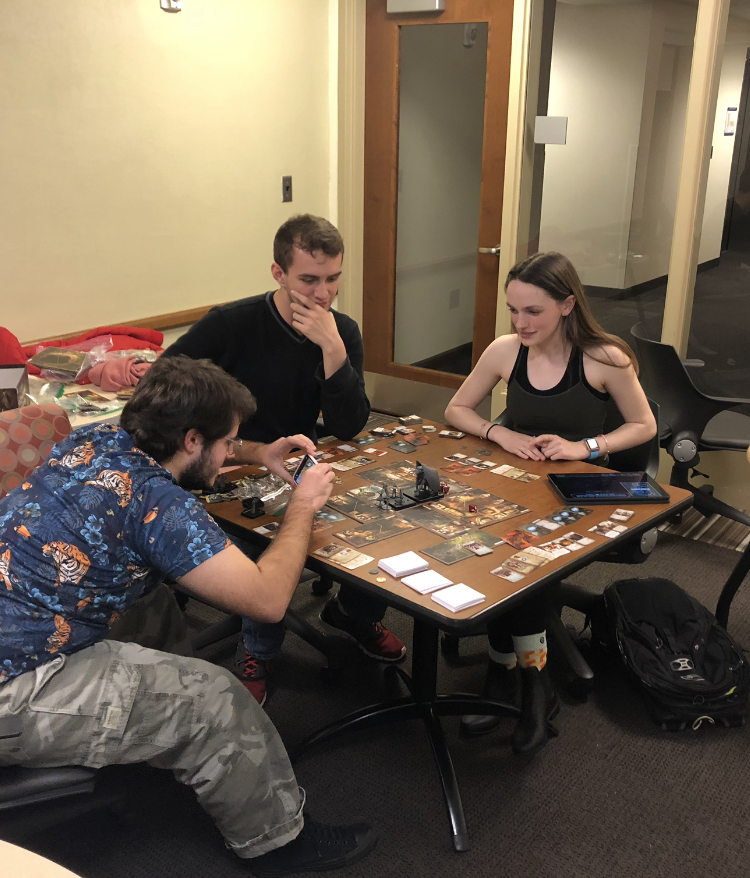
My friends and I got together to play Mansions of Madness. We were all thinking about how we did not have time to play for super long, but we had to get it done. We allotted a good amount of time just in case learning the instructions took a long time. Luckily, we had one person among us who was not a rookie, and he led the ropes.

The interesting thing about Mansions of Madness is that it is a physical board game with an interactive component that allows your story to completely change. I was excited to download the app on my iPad and play narrator. At the start of the game, we were each making our own decisions about where we wanted to explore, but as the game continued on and monsters started spawning, we had to be more strategic. I like how the game strongly encouraged teamwork.

We all had to make group decisions to stop the cult ritual and to eventually escape the mansion. We worked together to make sure everyone stayed alive, and we played our cards so that the strongest attacker could defeat the monster quickly. It got quite interesting when we thought we were being smart by staying out of range of the giant monster. However, it moved again and got directly between us and the doorway.

Here, we were confronted with two monsters, but we had one clear goal and that unified our team. This board game, with the interactive component, made it special. We could fight monsters and unlock rooms in a mansion one adventure at a time. It made the adventure unique to us, and it changed the way we made group decisions.

Overall, we decided that we want to play the game again, but a longer and more difficult version next time. We unexpectedly had so much fun, and when the game was over, I found myself wanting to keep playing.

A Reflection

Producing this podcast took a considerably longer time than I expected. I roughly estimate that I spent twenty hours on it, from going through the video game again to refining the audio. My two group members (and meeting with my professor and interviewing a friend) have been a source of ideas and of great help to me. Cherie and Kimberly voluntarily agreed on recording together, which took about five hours. Even my line producer readily agreed to refine the audio with me. I am truly grateful for my group members. 

Although I have participated in making a podcast in high school, I, regretfully, did not participate much. As a result, I failed to recognize the importance of a script. Even a seemingly informal chat on a podcast could result from recited and practiced lines. A full script in advance might not be necessary, but talking with nothing in hand is quite stressful. I am prone to stress, and stumbled over words frequently while we recorded without reading. I have a long way to go to achieve fluency in the English language, as I learned this from my imperfect TOEFL scores. Hearing my recording certainly reminded me of the fact once more. The first half of recording without a script became the major reason I spent hours editing the audio. 

Using Audacity gained me a new skill, and I always enjoy acquiring new skills. Another thing I thought of while editing the audio was how I can appeal to the audience. The writing in podcasts differs from traditional school essays. It is less formal. More importantly, the audience is not paid to read pages crowded with words, but someone who seeks for entertainment. I realized a tinge of humor might help. Whether I achieved this purpose I know not, but the experience of attempting to amuse the audience is new for me. 

I value the experience of producing this podcast, and hope someone will enjoy it. After all, I chose this over enolates last week. Finally, a link to the podcast: https://eng101s20.davidmorgen.org/ready-set-game/03-do-i-scare-you-doki-doki-literature-club/ 

Ph’nglui mglw’nafh Cthulhu R’lyeh wgah’nagl fhtagn

The moment I opened the box of Mansions of Madness and saw the bat-winged, octopus-headed humanoid I cried out in joy. That is one of the most well-known Great Old Ones, Cthulhu. And this board game did turn out to be extremely Lovecraftian. The 2018 video game Call of Cthulhu visualized a mansion from Lovecraft world, too, and even the dining table looks strikingly similar. Even in one of the item descriptions, a fragment of the famous Cthulhu chant appeared. Of course, I recognized it within a second. So much for the first impression.

If the definition of “board games” are games that involve a board and movement of pieces, I wonder if I can truly call Mansions of Madness a board game, for it relies heavily on an application. Surely, I can imagine using another set of dice and rule book (or story book?) to replace the app in the game, but the combination of technology and traditional board and pieces gives quite a different experience. A few cut-scenes, images, voice-overs and mini-games add to the sense of reality. Mansions could be made completely into a video game, too, I believe, but that would take away the fun of collaboration with a person sitting next to you. This board game, similar to many others, relies heavily on chances. In a video game, you make an action, and it would likely cause an effect, so skills are critical. For example, in a game like Dark Souls, you can practice to win a boss fight. In Mansions, practice of playing the game can hardly change the outcome of the dice. Here is a simple example, if one player keeps encountering monsters in “Mythos Stage,” while another never does, the difficulty each player faces is different. Therefore, the importance of strategy in this game, in my humble opinion, exceeds a number of video games. Being good at a board game like Mansions requires the player to excel in decision-making, not button-pressing. S/he has to consider not only one step, but the steps after that, and calculate the probabilities.

However, Mansions of Madness does have a more linear story compared to a number of video games. The number of obstacles (fires, monsters, accidents, not mini-games) a player encounters can vary; yet, the plot stays the same as soon as the game starts. The butler will stay the bad guy, no matter how many monsters you kill. The probing in Mansions, though, is similar to that in video games. There are underlying patterns to be discovered. For instance, choosing to attacking a monster tends to be more effective than evading it in “Investigator Phase.”

Can I be driven to insanity?

By Rachel Vellanikaran

Last week, I played Mansions of Madness with Austin and Zamirah. It took an excessive amount of time figuring out the rules and game set-up, but fortunately Austin had some prior knowledge that sped up this initial process. I liked how the game incorporated the use of an app; it was interesting engaging with the two different gaming mediums for one game. Since the game was taking almost over two hours to play, we didn’t end up making it to the final objective, but I still feel like I got a grasp of it’s decision-making and role-playing aspects. It felt like the overall objective was to maintain your physical and mental strength, but more importantly to ensure you didn’t lose your sanity(while also solving the mystery). If you lose your sanity, both you and your team investigators are in danger or at a serious disadvantage. For example, once you’re officially insane, you can complete “Insanity Conditions,” which could include setting fires throughout the mansion or using whatever weapon you have in hand against other investigators. My character, Rita Young had lots of physical strength, but poor sanity. And at one point, I kept racking up horror cards due to unforeseen monster encounters and the like and was too close to insanity level; but I never quite got there. Though it would’ve been unfortunate for my team members, I kind of wanted to see the change and diversity of outcomes in the game after going insane.

In terms of decision-making, I think there was quite a bit of strategic decision-making, from initially choosing your character and their respective strengths/weaknesses/ability levels to exploring or interacting with various objects, rooms, clues, and monsters in the mansion. This incorporates that telescoping and probing aspect as well. And for us at least, this decision-making was very collaborative as we were all determined to reach the end goal. For example, if Austin or Zamirah were exploring a clue, I would try and fend off a monster in another room since Rita, my character had the most physical strength compared to the other two investigators. We also chose to give my character the heavy weapons, since it would be most beneficial to her.

Overall, I really enjoyed Mansions of Madness since it’s basically my first time doing any role-playing-type game. I’m hoping I can play it through completely when I have more time. I’m still very curious about how reaching the state of insanity changes the game…

Us Three Girls Plus One Boy >> Doki Doki LC’s Podcast Creation

Doki Doki Literature Club was a game heavily focused on the visual contrast of expectations between gore and adorable girls. When we first started the podcast, we decided that it required first-person experience. Both producers browsed through playthroughs, reactions, and reviews. I acquired my understanding of the game by playing through the actual game from Steam and browsing through game mods, memes, and game conspiracy theories. One theory was how the online store merchandise gave quick ideas of how this game hid a story about dystopian religious camps and human experimentation. My Co-Producer focused on the description of Doki Doki Literature Club on Steam and on secret ends. We both played the game.

The creation of a google doc is where we added ideas to each other. Texting was important, and we had spent one whole day going through the run-through of the podcast. An outline was included. During the podcast, subtopics and free-style talking was emphasized. The editing re-ordered the subjects wherever we left off. Typing out a quick script of dialogue in response to the partner’s really helped organize our thoughts. When either of us were stuck, we had suggestions as a group worked out. The line producer voice acted and edited the audio along with us.

We decided against the whole summary format of the game compared to the Android Podcast, because the game was simplistic and focused more on mechanics and character. We also were inspired by the gameplay aspect of 99% Invisible and the personal anecdote styles from the “What Would You Do If You Were An Android”. Also the advice in class about using music as talking cues helped inspire us and was included in our podcast.

Our primary goal was to exploit the 4th Wall Breaking theme and how it relates to the microecology and larger ecosystem of games and society. Ultimately, we wanted to show how it becomes a self-conscious and emphatic game that borders visual novels and games compared to other media. We used to Genre, Purpose, Audience, etc. outline. Articles from the creator’s interview explained game purpose and design. A challenge that arose was the explanation of mechanics and how in depth it should be in order not to overshadow the general storyline. This was solved by focusing on the coding and minigames while implying visual novel elements. It would be preferential to describe how game modifications and code analyzers added complexity such as hidden codes character symbolism.

Through the final outcome, we achieved composing texts in multiple genres by restating articles of creator opinion in the podcast, using audio to summarize the summary text of the game page, and voicing dialogue between characters. We analyzed Salvato’s claims and purposes to relate the game’s 4th wall breaking themes and its role in microecology. We used a google doc to organize rough drafts, outlines, and a script. Finally, we added credit sources to the podcast’s description properly.

NOTE: I am most proud of the hilarious voice-acting in the podcast. Creative thinking definitely improved since we took a lot of inspiration from outer sources leading to voice-acting and music variety.

LINK TO THE PODCASTS: https://eng101s20.davidmorgen.org/ready-set-game/ready-set-game-the-rhetoric-of-games/

Betrayal at House on the Hill: “I spent three rounds running away from you, now you tell me you can teleport?”

Probing was definitely a big part of my game experience. The first time we played the game, we did not thoroughly read the rulebook, because it seemed long and a lot of the rules are talking about the second stage of the game instead of how to begin the game. So I think we did more “probing” than we should have, we discussed and tried to figure out the structure of the three floors of the house, how the characters can move depending on their speed and draw different event, item and omen card based on the instruction on the room cards. It was fairly simple until we got to the haunt part, one thing unique about this game is going back and forth between rule books, and apparently different roles (traitor or heroes) have different parts to read and cannot be shared with the other group. We ended up with a haunt that involved a lot of “telescoping”, which basically states “to do this”, you need to “do that”. The hero side had to gather candles and light them up in a specific room with rolling the dice to a number higher than 5. The telescoping was basically to gather the candles, you need to get to these rooms, which might involves building new rooms, and to light up the candles, you need to carry the candles to a specific room and rolling the dice. But on your way to the room, you also need to be careful about your candles are not stolen by traitor, or not killed by the traitor or monster. The fun part was that because traitor and heros have their own rule books that cannot be shared with the other sides, there are usually some mystical power and ability that seems unrealistic and coming out of no where. There were many skeptical looks at the other side: “is this really in the rulebook?” “Are you sure you did not just made that up?” Of course we shared our ability after the game, but the randomness added some spice to the game. The decision making wasn’t a big part of the game, as most of the battles are determined on what you get from the dices you roll. But the dice absolutely added a lot randomness to the game. We had situations where one side has two dice to roll, and the other side has four dices to roll. However, the two dices ended up having higher number than the four dices. In other words, you could expect to win the game as you see your numbers of each characters are really high and still ended up losing the game. But that’s also the fun part of it, there is no way to tell who is going to win until the very end. There are also so many types of haunts, each having its own setting and little stories to them, adding more excitement to the game. The experience of playing the game was great, and I would definitely play it again at some point.

Alan Li Side Quest 6: Reflection on Betrayal at the House on the hill, Being balanced is better than especially good only at some traits

I played the board game Betrayal at the House on the Hill with Keita, Ruohan, and Kathy. Although we watched the tutorial videos ahead of time, figuring out game rules took us roughly 2 hours. The game is complicated but well designed with many possible endings, and I am really interested to explore other possibilities after we successfully played the first round.

The probing and telescoping part of the game is largely exploring rooms, character strengths and weaknesses, and collectible items. Different rooms have different arrangements of doors and exit rules that sometimes relate to character traits. Doors have to be present on both rooms for a successful addition, and speed limit of the character limits how many rooms each character can move/add in a single hand. My character was Darrin “Flash” Williams, who has high speed but mediocre/low in might, sanity or knowledge. Darrin was great in the exploring part and was able to open almost as many rooms as I wanted and moved freely across the house, but my weaknesses started to show when the hunt started. Collectible items are used when the room tells the character to pick an event/item/omen card, which can either help or hurt the character capability. These cards are really helpful for characters during the hunt started. Some of the cards enhances some traits and can be very helpful for some characters low on that trait.  

Decision making is a central part of this game. Before the game started, I chose my character for his absolute advantage in speed, which enables me to escape or move to ideal location much faster than any other character. And in the game, many times I have to choose whether to open a new room or stop at the current room then pick the card indicated. And some cards require sacrificing one trait for another, whether or not to make that exchange was crucial for the character’s ability. After the hunt started, decisions are even more important. As we played hunt #43, it required explorers to light candles with speed roll more than 3 and move the candle to another room with knowledge roll more than 5 to place the candle. When the candle placed is equal to the number of explorers, the explorers win. Otherwise, the traitor wins. And the hardest part to win is to deal with the immortal monster. Collaboration became crucial for winning in the hunt. My character was great in speed but weak in knowledge, which led me to light the candles and move them to Kathy’s character, who was great in knowledge but weak in speed. Even though we tried to work together, the traitor with monster was hard to defeat. Monster could move freely to any room in the house and challenge me, even with my high might (enhanced with armor card), I could only reduce might from fighting with the monster and unable to kill it even if I won. My high speed became useless while facing the omnipresent monster. Also, the traitor kept challenging me on knowledge and sanity rolls, which I was weak and constantly in the brink of dying. My luck in rolling kept me alive many times. That is when I realized having balanced character traits is far better than just being great at one or two of them. It is more likely to die and lose when the traitor keeps challenging you with your weakest trait, and your strong traits will not even have the chance to take effects. Items like the armor that makes traits interchangeable allows more variability and skills to play the game well. More uncertainty with the many hunt rules also makes the game more complicated and fun to play with.

For the argument Steven Johnson made in Everything Bad is Good For You, I think the opposite holds true after playing with this board game. While video games have the rules programmed into the software and stop the users from making illegal moves, board games are a lot harder to play by the rules, which is why it took our group such a long time to figure it out. There was no one telling us what are moves we can do or cannot do. When confusion comes, a lot of reading and explaining is needed to have everyone understand and agree on the rules. This is much more time-consuming and harder than video games.

This game is far more complicated than any other game I played before. The progress of the game is nonlinear and have many alternative paths and possible endings for players to find out. The event/item/omen cards are crucial once the hunt starts and can change a character’s ability completely when facing with different goals. Luck, skills, and collaborations are very crucial in this game, which makes this game highly unpredictable and fun to play with.

I NEED ANOTHER CLUE!

Here we are going to talk about Mansions of Madness. Yes, that game with that ridiculously long rulebook to teach you how to be a decision maker in the game. At first glance, the game is daunting in its medium as it gives a lot of rules that you would only expect to be doable in a video game. However, the combination of the app that the game requires and the board game combined makes the game very interesting to play. In my opinion, the goal of the game is to protect yourself from becoming insane. I think that it better to become physically harmed than insane because when you’re insane, you become a hazard for other players as well. So, my team (Austin, Rachel, and I) made it our mission to not become insane by any means necessary.

So, let’s talk about the decisions that was made in order to ensure that none of us went insane. Foremost, we all got card that balanced each other’s weaknesses out. For example, Rachel had the character with the most physical strength, so I had the character with the most sanity, while Austin fell in the middle of the two extremes. This kind of did not work out the most for us as Rachel had the least amount of sanity, but unluckily had the most amount of horrors. However, I luckily continued to get clues which took some of the pressures of my fellow player, Rachel. MANNNN we love those clues. Hence, through the decision making of keeping a balance, we were able to keep the game going on for a while. In the words of Austin, “let’s get these d**n monsters!”

css.php